Hope Unleashed: The National Disaster Search Dog Foundation in Venezuela
Venezuela, located at the northernmost tip of South America, occupies a typically enviable spot in the middle of the tropics. Gaze northward from a beach there and you’re taking in both the Caribbean and the mighty Atlantic. The country also sits atop a tectonic meeting place, a boundary where the Caribbean and South American plates meet in a transform fault system. Also called a strike-slip, this fault separates two argumentative tectonic neighbors. The Caribbean and South American plates have been pressing and sliding horizontally against each other for millions of years with unimaginable force. Grinding along at a lateral velocity of about 20 mm (0.8 inches) per year – approximately the rate at which your toenails grow – brute friction kept the tectonic tussle on the undetectable lowdown; until June 24 when the plates massively slipped.
“The absolute magnitude of the devastation,” says Denise Sanders, “and how concentrated it is in the very densely populated areas that they’re working in… they’re very, very aware of the fact that there are many people still missing in the very large buildings that collapsed upon themselves.” Sanders is senior director of Communications and Search Team Operations for the National Disaster Search Dog Foundation, and she’s referring both to the six human/canine teams trained by the Search Dog Foundation and deployed to Venezuela, and to the larger task force of which those teams are a part; USA-2 out of Los Angeles County. The Search Dog Foundation is an intricately devised and exactingly trained human/canine partnership begun in 1996 whose sole mission is to find living people trapped in rubble. Anywhere in the world.
“I’m sure when they return from Venezuela, we’ll debrief and we’ll hear what they’ve learned, just as we’ve done when they’ve deployed to Turkey or Nepal or Japan, or Haiti, all the way back in 2010. We learned a lot from those deployments and so we were able to replicate some of the search scenarios.” In 2017, the SDF’s privately funded National Training Center (NTC) launched in the woods near Santa Paula. NTC is not a grassy field where tennis balls are thrown and fetched, but a sprawling, 145-acre nightmare mock-up of all the possible disaster scenarios for which SDF’s canine rescuers are rigorously and lovingly trained. A map of the NTC includes such place names as Rubble Pile, Train Wreck, Collapsed Freeway, Tilted House, and more. Sanders explained to me on another occasion that the whole of the enormous, rolling compound, a selection of actual toppled buildings, derailed freight trains, and in one instance a collapsed house with an airplane sticking out of it, are built to code.
“The search scenario itself,” Sanders says, “what is to the dog that scent picture, we’re able to replicate that on our campus where we have training props of all kinds, including a collapsed freeway. We do have an area that mimics a neighborhood hit by an earthquake or other natural disaster. The teams have trained on something similar to what we’re seeing in the media images out of Venezuela.”
7.2 and 7.5
Few phenomena highlight frank human frailty like an earthquake. You can flee from the approaching effects of this or that calamity, but when the ground under your feet goes haywire you’re at the mercy of the tumbling “world” itself. So it was that on June 24, at 6:04 p.m. local time near San Felipe, Yaracuy, Venezuela suffered what geophysicists are calling a “seismic doublet.” On that late afternoon, two explosive quakes detonated under northern Venezuela, separated by a scant 39 second interval. Nature has no volition, but sometimes these “accidents” can look like wanton cruelty. The immense release of energy that caused the first 7.2 quake also transferred stress further down the fault system, causing another huge slip – the larger 7.5 magnitude quake on the heels of the first. The combined subterranean detonation has been calculated as having the explosive force of 180 to 260 Hiroshima atomic bombs, causing the loose sediment of the Yaracuy Valley to undergo concussive liquefaction, the ground itself dynamically lurching like a semi-solid, or a tablecloth being whipped free of crumbs.
High-rise buildings in the hardest hit areas of Venezuela – the coastal state of La Guaira, the capital city of Caracas, the adjacent surrounding states of Miranda, Aragua, Carabobo, and Falcón –vertically pancaked or toppled like toys. Survivors report hearing the immediate screams of the trapped when the buildings came down. The chaos and complexity of the wreckage, the various difficulties of picking up a scent, have been trained for.
“We know that they can handle diffuse scent,” Sanders says. “For instance, when we’re seeing these multi-story apartment complexes that have collapsed and we have to assume there could be victims beneath the surface wreckage, teams have trained on scenarios where the live human odor is deeply buried, or it’s so far under this concrete it’s coming up the sides and it’s more diffused. The dogs’ training is an experience that they can absolutely fall back on, and not something brand new they’re having to figure out in the moment. That is what it is all about at the Search Dog Foundation; making sure that they have that training in place long before they step off the plane or off of that truck.”
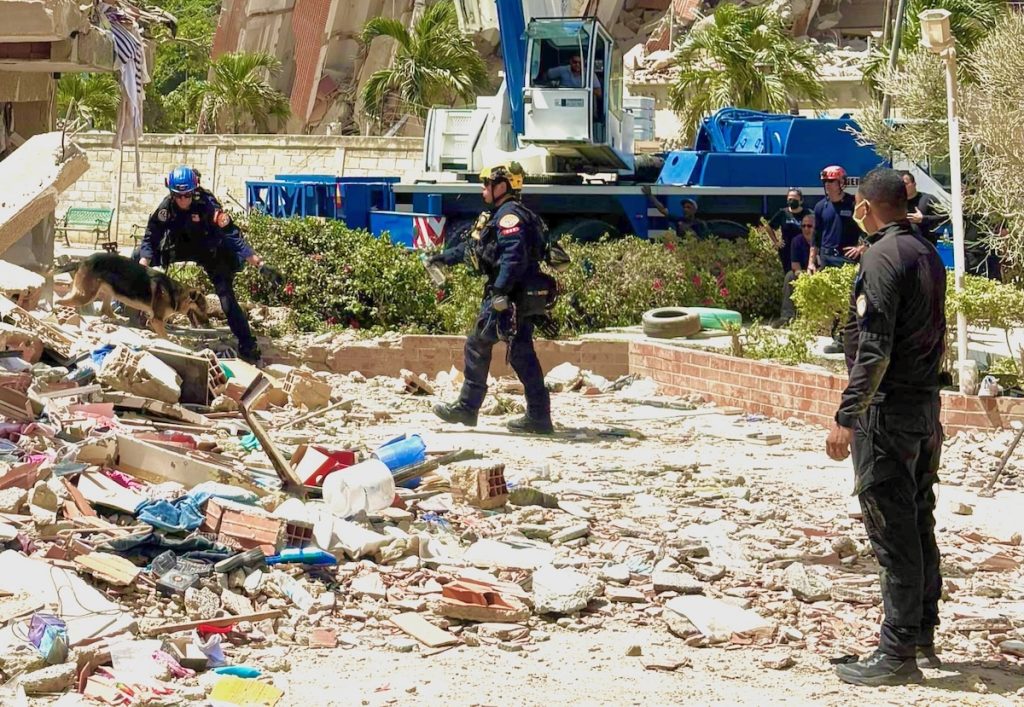
At this writing the official death toll from Venezuela’s spontaneous twin quakes has risen to at least 1,719 fatalities, with 5,034 people confirmed injured. Geologists warn that these figures will scale upwards. 46,600 to 50,000 people remain missing as rescue teams swarm the sometime unstable rubble of collapsed high-rises. The NSD training is in large part defined by the unbreakable bond between the canine and the handler, who have effectively partnered for life. It’s no surprise they travel to these devastated hot spots together.
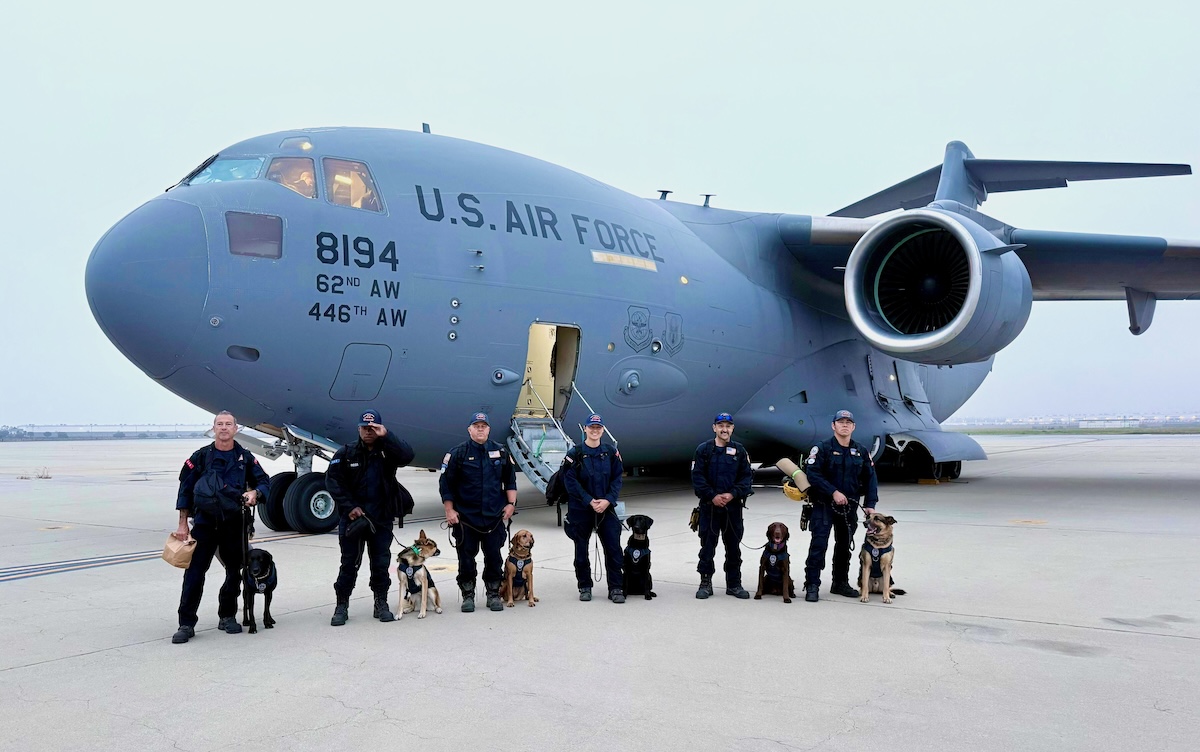
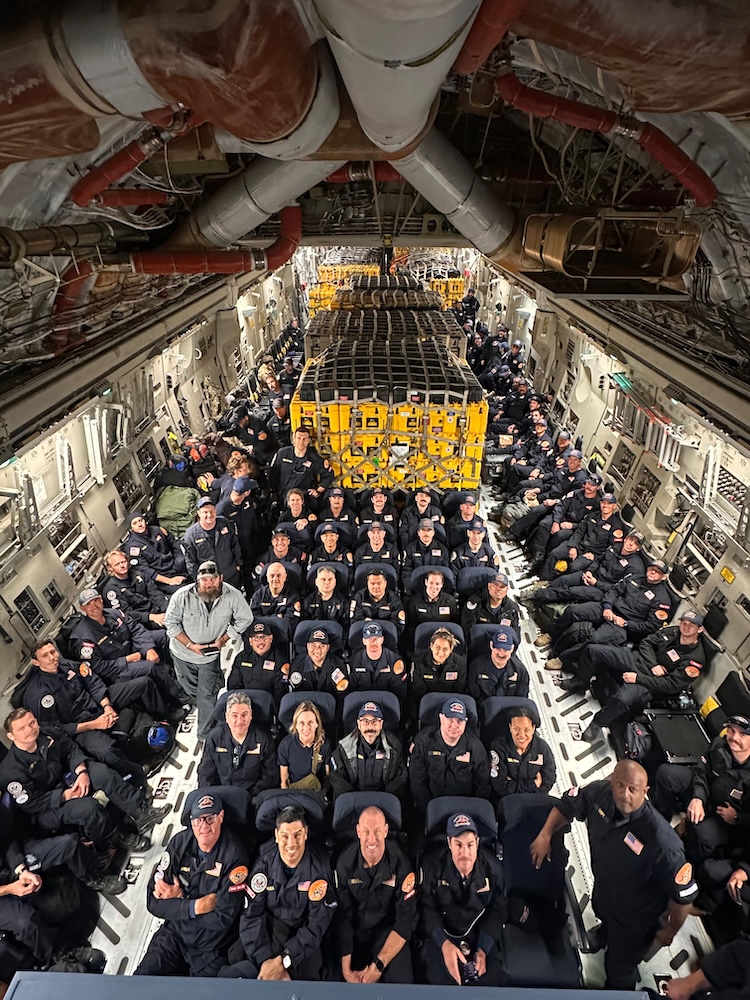
“They deployed under the Department of State and so they flew military,” Sanders says. “As you can see in one of the photos, the entire task force, again, it’s 75 people, six canines and something close to 80,000 pounds of supplies, equipment and machinery, are all loaded onto the cargo plane and they all travel together. They travel as a big team and they land together, unload together, they set up their base of operations.”
Venezuela has taken an unimaginable blow, but when the lights dim, international borders fall and the human species shines. The UN has deployed over 2,245 specialists, 140 search dogs, and has activated its UNOSAT satellite imaging to guide rescuers through the fields of debris. The U.S. government initially pledged $150 million and later increased its commitment to over $300 million in direct humanitarian relief. Rescuers, medical supplies, and heavy machinery have poured in from Latin American and Europe. Israel’s IDF Home Front Command has dispatched a highly specialized engineering and emergency response delegation. India’s Army Field Hospital unit has set up portable hospitals at the La Rinconada Racetrack in Caracas, the UAE has donated direct relief funds, and the UK has provided seismic listening technology and drones.
Perhaps most significantly (at least in the realm of full, heartening circularity) many of SDF’s dogs are themselves rescue dogs. I had the privilege of witnessing, at the National Training Center one sunny day, the ceremonial partnering of these life-saving canines with their handlers. To imagine what these directed teams, these paired friends, are sent to accomplish – whether across the seven seas or across the U.S. – is to understand the bond, the power inherent in the bond and, in these emotionally dire assignments, the sheltering strength of friendship.
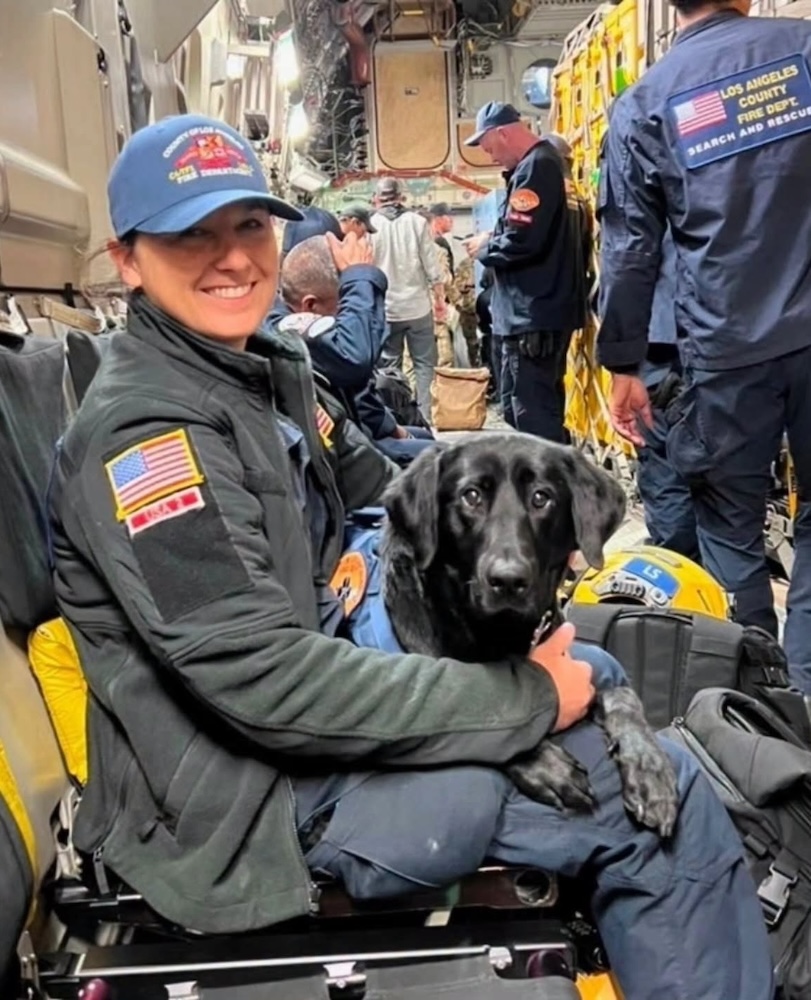
“I think having your canine partner at the end of the leash with you probably helps a lot for the canine handlers,” Sanders says when asked about the degrees of trauma associated with this work. The dogs in the field have been trained such that they are engaged in a loving and joy-filled exercise and they nimbly traverse broken urban hellscapes in search of the living.
“They don’t care where it is,” Sanders says with a smile. “These dogs get to be there with their favorite person in the world, doing their favorite thing. There’s something really wonderful about that. Amidst the heartbreak and the devastation, to know that these dogs go from rescued to rescuer – not because they have to, not out of desperation, but because they absolutely love what they do, and they love the people they’re working with…” Sanders breaks off. Venezuela is undergoing a generational tragedy of the deepest, most wounding kind.
“It’s about the victims. It’s about saving lives with those dogs that are down there now. So for us it’s high stakes,” Sander says. “But for these dogs it’s the best day they could possibly imagine, and I wouldn’t want it any other way.”
National Disaster Search Dog Foundation
Donate now!www.SearchDogFoundation.org
(888) 4K9-HERO
(805) 646-1015
Executive Director: Rhett Mauck
Mission
Our mission is to strengthen disaster response in America by rescuing and recruiting dogs and partnering them with firefighters and other first responders to find people buried alive in the wreckage of disasters.
Begin to Build a Relationship
We know you care about where your money goes and how it is used. Connect with this organization’s leadership in order to begin to build this important relationship. Your email will be sent directly to this organization’s Director of Development and/or Executive Director.
Over the years, the Search Dog Foundation has forged numerous partnerships with canine disaster search teams that proudly serve the Los Angeles area. We deeply appreciate the presence of these remarkable canines in our ranks, standing as a steadfast resource we can rely on when summoned to action by the Los Angeles County Fire Department and California Task Force 2. Our task force holds the distinction of being one of only two in the nation with the capacity to deploy internationally, and the indispensable role played by our search dogs cannot be overstated. In the face of earthquakes, hurricanes, mudslides, or the daunting challenge of locating missing persons, these exceptionally trained canines form the bedrock of our search missions. Whether the need arises close to home or on foreign soil, these four-legged heroes ensure that our operations are successful. It is of utmost importance to highlight the unwavering support provided by the Search Dog Foundation, which generously supplies these canines as invaluable assets to our department and task force. This unwavering commitment ensures that we are perpetually ready and equipped to serve our community whenever the call for assistance rings out. Together, we stand united, ready to bring aid and hope in times of crisis.
Sponsor the Canine Heroes
The frequency and strength of recent disasters are stark reminders that they can strike at the heart of any community. In the search for victims, a search dog’s remarkable nose and hard-earned skills mean the difference between days versus minutes, lost versus found, uncertainty versus hope. The National Disaster Search Dog Foundation (SDF) works diligently to ensure canine search teams across America can deploy at a moment’s notice when needed, which includes preparing the next generation of canine heroes.
From the day they arrive on campus to the day they are paired with first responders, SDF spends approximately $75,000 to train a search dog over 10 to 12 months.
SDF is raising $975,000 to train the next search dog graduates. Donors at $20,000 and above can become sponsors of a search dog in training, receiving updates on their progress and milestones throughout their career. Sponsor one or even a pack of canine heroes to be Part of the Search!
Board of Directors
George Leis, Chair, Executive Vice President & Market President, CalPrivate Bank
Richard Butt, Vice-Chair, Retired EVP, Executive Creative Director, VMLY&R
Deborah Whiteley, Secretary, Communications Consultant
Christine DeVries, Treasurer, Retired Financial Services Executive
Elena Brokaw, The Barbara Barnard Smith Executive Director, Museum of Ventura County
Michael Cesare, Management Consultant, KPMG US LLP
Robert Harris, Deputy Fire Chief, Los Angeles County Fire Department
Sydne Levy, Attorney, Brownstein Hyatt Farber Schreck
Andrew MacCalla, Co-Founder and CEO, Collective Energy
Rhett Mauck, CEO, National Disaster Search Dog Foundation
Crystal Wyatt, Leadership in Board Governance and Creative & Sustainable Philanthropy