Dr. C. Noel Bairey Merz and Margery Tabankin: Driving Life-Saving Philanthropy to Women’s Heart Health
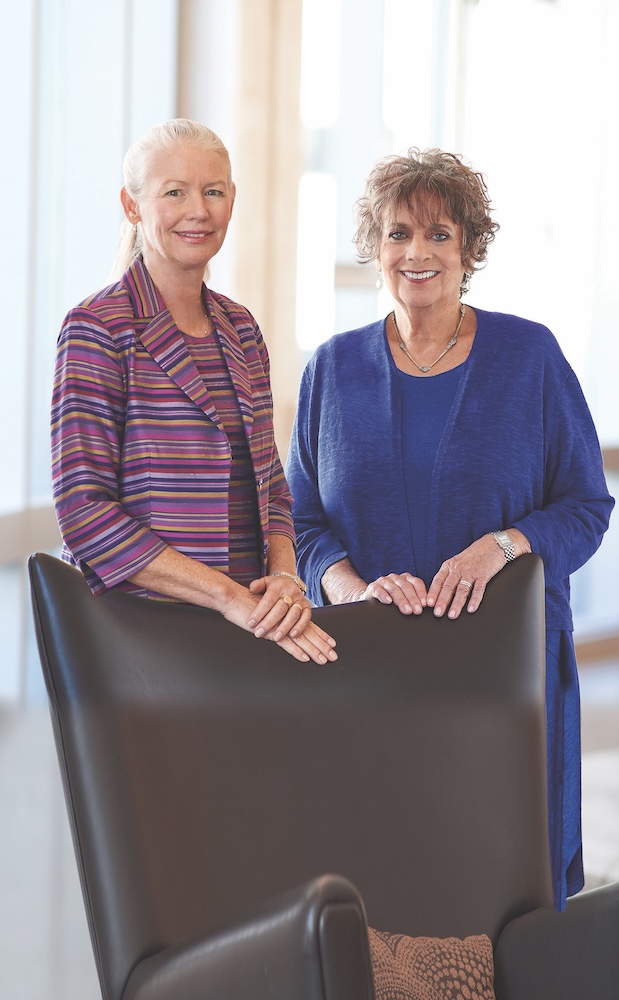
Dr. C. Noel Bairey Merz, MD, MACC, FAHA, FESC is a cardiology rock star. She holds the Women’s Guild Endowed Chair in Women’s Health and is the director of the Barbra Streisand Women’s Heart Center, the Linda Joy Pollin Women’s Heart Health Program, and the Preventive Heart Center at the Cedars-Sinai Smidt Heart Institute, where she is also a Professor of Medicine. In addition, she is an internationally recognized pioneer and leader in cardiovascular research, advocacy, and education. Dr. Bairey Merz has been at the forefront of many women’s heart health research initiatives and has been educating women on how to recognize female-pattern heart disease symptoms.
Dr. Bairey Merz is also working to correct the gender inequalities in clinical research studies, as well as breaking the glass ceiling and advancing more women in academic medicine. For her steadfast advocacy in promoting and mentoring women cardiologists in their medical careers, Dr. Bairey Merz has been awarded the prestigious Bernadine Healy Leadership in Women’s Cardiovascular Disease Award by the American College of Cardiology in 2016.
Margery Tabankin is a public service luminary with a career that spans 50 years. Her experiences range from leadership roles in government, to philanthropy, to nonprofit organizations, to politics and public policy. Whether as advocate, activist, policy analyst, organizer, or documentary film producer, equality, and justice have been the consistent throughline of her work.
Past clients include Barbra Streisand, Steven Spielberg, J.J. Abrams and Katie McGrath, and the Hollywood Women’s Political Committee, among others.
She currently serves as a consultant to Cedars-Sinai Medical Center, providing strategic advice to the Barbra Streisand Women’s Heart Center and, at the national level, the Women’s Heart Alliance.
The Giving List had a chance to talk with both Dr. Bairey Merz and Ms. Tabankin about philanthropy’s role in helping drive innovation and life-saving solutions in medicine.
Here’s what they had to say:
The Giving List: Philanthropy helps drive innovation in medicine. But there is a big gap between where federal funding often goes in terms of research and what is actually needed based on the statistics of what people are truly suffering from. So, for example, in 2050, it’s projected that more than 61% of American women will suffer from some form of cardiovascular disease but only 4% of the National Institutes of Health (NIH) budget is allocated to women’s heart disease. How does this gap underscore the need for philanthropic support?
Dr. Bairey Merz: This has always been true for women, particularly in women’s heart disease, because it has historically been dominated by research in men, for men and by men. Without the ability to get seed money – to test innovative strategies, designs, and trials – we never would have known about the sex differences in cardiovascular disease. And when we did investigate some of these differences via philanthropic funding, it opened up more extramural funding from the NIH. Philanthropy is even more important right now because of the chaos and challenges at the NIH. This is a time to step up, so we don’t lose ground. When I first started working with Barbra Streisand, we saw that we were 50 years behind in understanding sex differences in heart disease. We’ve made up 15-plus years (maybe getting close to 20) – that leaves 30 years we still need to catch up to ensure that 51% of the population receives care as good as the care men receive today.
TGL: As you mentioned, philanthropy played a big role in discovering that women’s heart disease is different from men’s. Can you talk to us about your discoveries and what led to the creation of the Barbra Streisand Women’s Heart Center?
Dr. Bairey Merz: I trained at Cedars-Sinai as a cardiologist specifically to get exposure to research, because I was always very curious and easily bored (which is a good trait for research!). When I was a cardiology fellow working on research projects – and maybe I noticed this because I was one of very few female cardiologists – I kept seeing outliers in the data, and they were almost always women. I thought, “That’s interesting… maybe women’s hearts are different.” So I started cultivating that as a line of investigation… The point is, I got interested in sex differences. As an investigator, I needed funding to do impactful clinical research in humans. It’s very expensive and highly regulated – safety is the top concern. I had been doing this research and publishing our findings. In medicine, we expect about a 10-year lag between publishing something and seeing it deployed in practice. Part of that is that physicians are inherently conservative – they won’t try something new until safety is 100% proven. And also, some of the old-timers don’t want to change their ways. After 10 years, I didn’t see anyone implementing what my team had described.
So I said, Okay, I’ll start treating patients. I opened a clinic and dedicated two days a week to see patients – basically to show that you can do this. That led to Barbra Streisand saying, “I agree, this is really important.” She didn’t directly fund clinical care, importantly she supported building the infrastructure of our Center to do the research and educate patients and physicians… And having Barbra’s name attached gave us recognition, which has been incredibly helpful.
TGL: You both are deeply involved in not just the Barbra Streisand Women’s Heart Center but also the national Women’s Heart Alliance. Tell us about the genesis of that alliance and what their efforts are focused on now in terms of women’s heart health.
Ms. Tabankin: As for how the Women’s Heart Alliance began: Ron Perelman noticed Barbra’s interest in women’s heart health. She had already funded an early research grant and then a major gift to Cedars-Sinai to establish the Barbra Streisand Women’s Heart Center. Ron had funded a women’s heart program at NewYork-Presbyterian/Weill Cornell (led by a great cardiologist, Dr. Holly Andersen). During a visit, he asked Barbra, “How do we get this to the next level?” She agreed it needed to go further, and together they came up with the idea of a national initiative called the Women’s Heart Alliance. Both Barbra (and Cedars-Sinai) and Ron provided seed money to start it. For many years Cedars funded it, but when hospitals had to tighten budgets, that support ended. We’re now replacing it with private gifts from visionary women who understand that philanthropy’s role is to spotlight an issue – bringing in more public funding through advocacy and research, and building understanding among women themselves. Unlike breast cancer – which gets a lot of attention because it involves women’s breasts – most women don’t even tell people they have heart problems.
We have made some progress: fewer women are dying of heart disease now than when we started (it was one in three, and now it’s one in four). That makes us feel good. We’ve also had some success with Congress – for example, getting the Department of Defense to create a line item for women’s heart health. (The DoD was the first to fund breast cancer research when the NIH wouldn’t, by pointing out how many women are in the military.)
Dr. Bairey Merz: One of my senior investigators has a saying – “investigate, educate, advocate, legislate.” …The Women’s Heart Alliance covers the “advocate” and “legislate” parts. If you don’t do those, if you only do investigation (which is what I do, and it’s critically important), then here we are almost 20 years later and still a majority of cardiologists – mostly male – don’t think women’s heart disease is very important. We can wait for the new generation I’m training (and they are much better about a lot of things), but meanwhile millions of women continue to be undiagnosed, underdiagnosed, misdiagnosed.
TGL: How can we help donors (as well as women in general) understand the importance of the issues and prioritize their role in helping drive philanthropic dollars to research for women’s heart health (especially as the federal government is cutting back research funding)?
Ms. Tabankin: A group of wonderful cardiologists and activists felt that the only thing that would drive further progress – and attract seed funding for research and the advocacy needed for policy changes – was public education. Unfortunately, this issue is still hiding under a rock. Most people don’t talk about it. A lot of people who die of “natural causes” or have heart problems don’t even understand their situation. So we’ve really focused on public-information messaging: get your heart checked, understand the symptoms, understand the problems of misdiagnosis… A younger generation is coming up – more women cardiologists are emerging – but the “pooh-bahs” on all the grant committees (at the American Heart Association and in government) still don’t give this epidemic the attention it deserves.
I can’t count how many stories we’ve heard of women who went to the emergency room – which is a big step, because many women would just lie down or “take a nap” instead – but were viewed as a little hysterical. They were given an Ativan or a Xanax, put on Prilosec, and told to go home and rest. Unfortunately, in cases we know of, they died within the next week of a heart attack at home, at night. Some women were actually saved because they got to the hospital in time, but it’s a nightmare. So a lot of awareness needs to happen.
TGL: How does the funding you’ve received translate into tangible impact for women?
Ms. Tabankin: I cannot tell you how many people have come to Noel – or invited her – to help start similar programs in other hospitals, in the United States and around the world. She’s gone to Israel, to Australia, to Sweden… Plus she’s always traveling around the U.S., doing grand rounds and meeting with cardiology teams about how to do this. I would say we still have the leading, state-of-the-art diagnostic, clinical care, research, and education program here in L.A. And we happen to be lucky that we’re in a hospital rated the best in the West and very high nationally in cardiology. Barbra is thrilled. It’s not easy in philanthropy to actually see the full impact of your work in a 20-year span, but she has seen it. She often tells me, “It’s the best gift I’ve ever made. It’s the best grant I’ve ever made.” She just kvells (bursts with pride).
TGL: Before you go – what’s one piece of advice you would give people to help them avoid getting cardiovascular disease in the first place?
Dr. Bairey Merz: It’s not just one thing – it’s living and breathing heart-healthy. But probably the best one is: get your heart checked. That’s the Women’s Heart Alliance’s primary message, and it comes with clear action steps. I’d add that if women feel you’re being patronized, get another opinion.
TGL: Thank you. And Ms. Tabankin, One final question for you. I’d be remiss if I didn’t bring up the Barbra Streisand Foundation’s generosity on so many fronts (including women’s health and rights). Without opening the floodgates, is there anything you can share about the Foundation’s upcoming philanthropic goals?
Ms. Tabankin: The Foundation has been dedicated to the same set of values since it started: women’s equality, environmental safety, a peaceful world, and democratic values. Unfortunately, even though it began in 1987, all those issues still need attention. At this stage, her philanthropy is focused on continuing to support the people who have been toiling in the vineyards for years – people she truly believes in. There are also new initiatives to meet current challenges, and her staff is always on top of those. Whether it’s voting rights or freedom of speech, those causes are very dear to her heart.