
Turning Instinct into Action, In Every Disaster Scenario
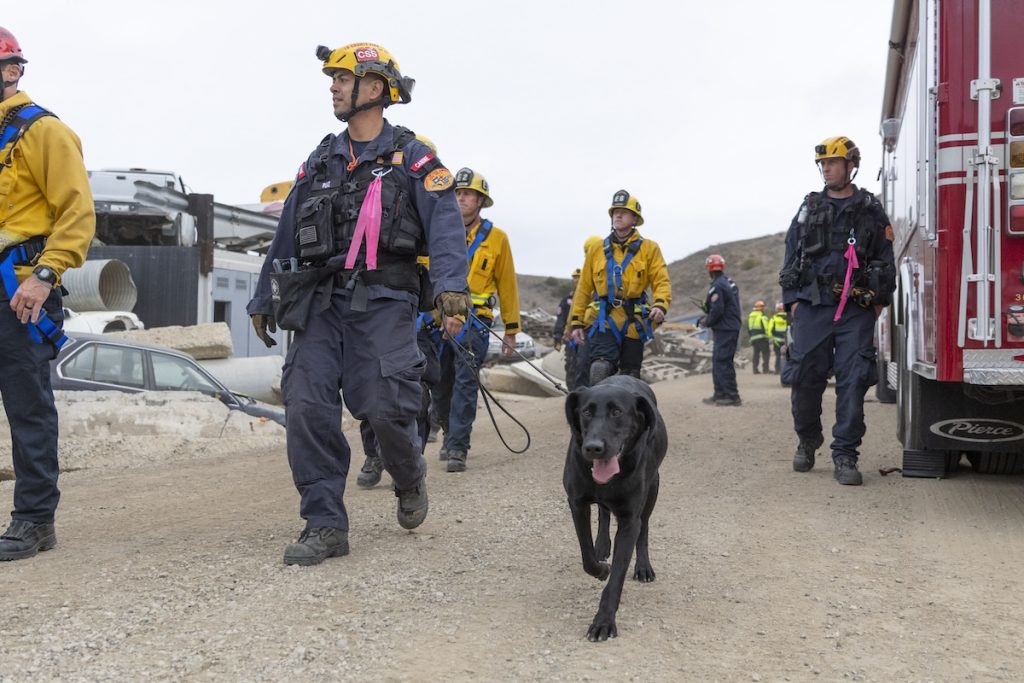
Wilma Melville founded the National Disaster Search Dog Foundation in 1996, a year after witnessing the dearth of rescue dogs available to search for survivors in the aftermath of the bombing of the Alfred P. Murrah Federal Building in Oklahoma City. Almost 30 years in, SDF, located in a rural area of Santa Paula, has become the state-of-the-art facility for training dog and handler teams in the exacting art of locating survivors of all kinds of disasters, from earthquakes, fires and floods to explosions and other damaging events.
The canines, who are adopted for life by their human companions, are themselves rescuees. National Search Dogs are most frequently found in shelters, where their exhausted owners have reluctantly surrendered them for being tirelessly engaged and frenetic play friends – qualities of “doggedness” that lend themselves to the time-sensitive rigors of disaster area rescue. The teams undergo an arduous training regimen at the SDF complex, where rubble piles are arranged to mirror disaster scenarios, and the dogs are conditioned to hone in on specific scents indicative of a potential survivor buried beneath.
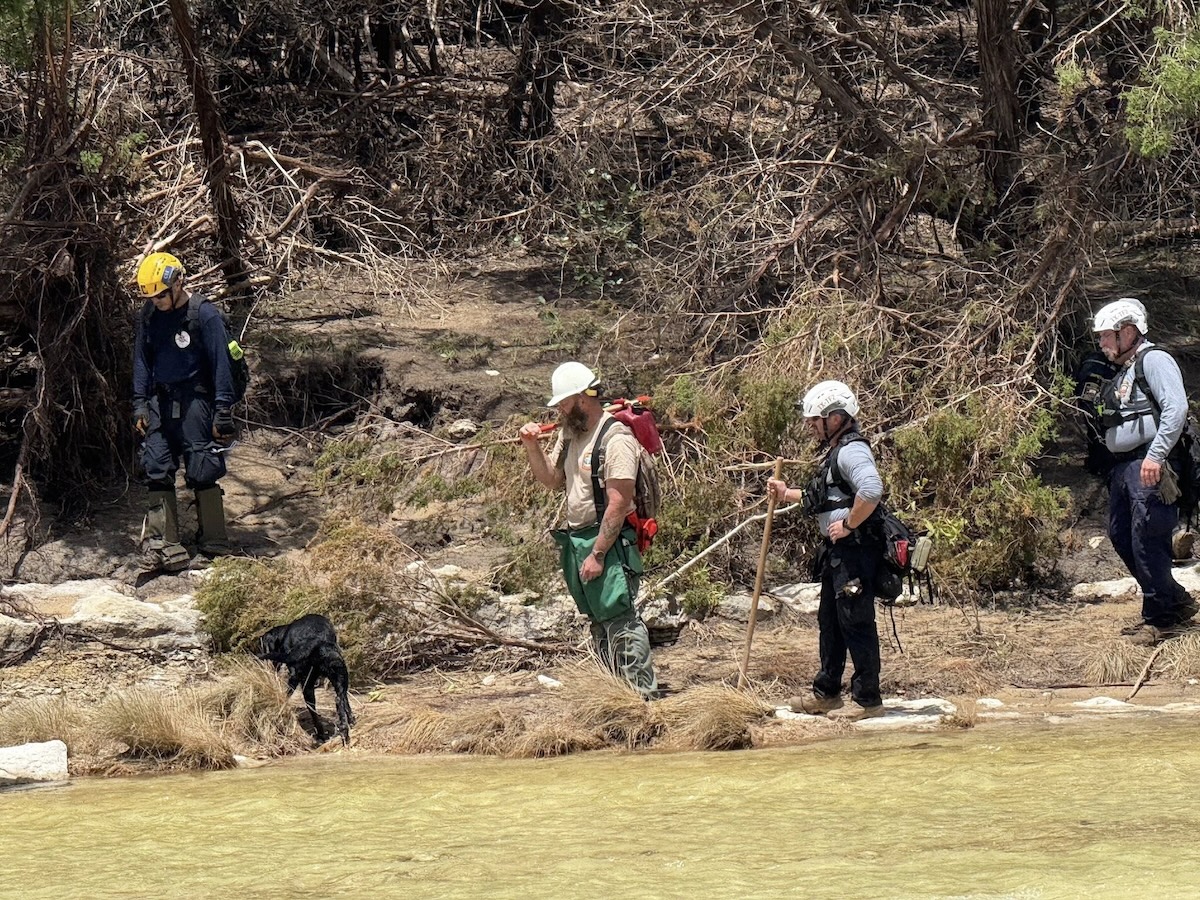
SDF teams, which come from all around the country, have responded to just about every recent natural disaster, from the devastating Los Angeles fires earlier this year to ferocious flooding that struck a Texas overnight camp last summer, and the devastating Turkish earthquake of 2023. But these sites also saw SDF-trained teams with an atypical SDF mandate – the recovery of remains after hope for rescue had lapsed.
“We have historically almost always been about Live Find – sending the dogs to help in that phase of a disaster that involves searching for survivors,” explained Denise Sanders, SDF’s senior director of communications and search team operations. “Finding someone in that window where they can be pulled out and given the medical care they need has always been a big focus. We wanted to make sure we focused on giving our all to providing Live Find dogs to those task forces who are out there for hours and days on end, pointing them in the right direction for where someone might be, and helping to clear an area so they can move on to the next one.”
But now that there are systems in place, both at the state and federal level, often due to SDF’s diligence, the focus has expanded, she said, noting that it was always part of Melville’s vision that the dogs be part of every phase of disaster response. That includes recovery of those who perished – which happens anywhere from a few days to more than a week after the incident.
“Recovering those who have been lost either during the initial disaster or afterwards is very important to start that closure process for their relatives and friends,” she said. “We wanted to be able to produce those teams too, not only training the dogs, but the handlers so that they are deployment-ready at a moment’s notice.
SDF began a pilot program a couple of years ago, and a few of those teams were on the scene both in Los Angeles and Texas.
“It’s about helping those families who want to get their loved ones home,” Sanders said. “Imagining those moments is horrifying, but if we can help with the closure process and be able to say either we have found your loved one or conversely that the dogs have not indicated a survivor in that area and the team can move on and search somewhere else – that is just so valuable.”
While the training process begins similarly, once they move on to the odor-detection phase, the dogs involved in recovery diverge from the Live Find canine-human teams.
“It’s scientifically very different because every stage of decomposition is different,” Sanders explained. “There’s a lot more odor discrimination that needs to happen, and the dogs actually need to learn how to detect all of those odors, differentiate between children and adults, and the subtleties of recovery after a fire versus a flood or earthquake. It’s very extensive. All of those different variables have an impact.”
That goes for the handlers, too.
“The handler needs to be educated and trained through all of those various odors, too,” Sanders said, adding that on top of the scientific specifics, “It’s a different psychological state of mind.”
SDF spends approximately $75,000 to train a search dog and handler team over 10 to 12 months, and the same goes for recovery pairs. In both cases the certified training is delivered at no cost to the emergency search and rescue departments who will employ and deploy the teams to disasters as needed. And whichever direction the dogs go – or even if they’re never deployed because they aren’t able to satisfactorily complete the training – the canine companions receive lifelong care, also at no cost.
“We have rigorous training requirements for our teams, including that they have to submit training reports every month so we can review what they’re doing, how they’re doing it, what challenges and struggles are coming up,” Sanders said. “Then throughout their entire career, they need to maintain that. If you don’t have that accountability in place, there is the potential for slipping even a little bit and maybe not keeping up that superior level. You never know when the deployment is coming. So if you’re not truly prepared at any given moment, are you really ready?”
Which is why SDF is also one of the places where canine-human teams fulfill their government-mandated requirement to recertify every three years, demonstrating that their skills, communication, and connection remain up to snuff. Again, that service is provided free of charge to the first responder organizations, even if the teams didn’t originally train with the organization.
All of which is even more impressive, given that SDF doesn’t accept government funding, in order to ensure there are no restrictions or interference with its top-flight training regimen.
Which is why philanthropic gifts and even small individual donations are the nonprofit’s lifeline.
“Every bit helps, and it all adds up so that together we can make a difference,” Sanders said.
National Disaster Search Dog Foundation
Donate now!www.SearchDogFoundation.org
(888) 4K9-HERO
(805) 646-1015
Executive Director: Rhett Mauck
Mission
Our mission is to strengthen disaster response in America by rescuing and recruiting dogs and partnering them with firefighters and other first responders to find people buried alive in the wreckage of disasters.
Begin to Build a Relationship
We know you care about where your money goes and how it is used. Connect with this organization’s leadership in order to begin to build this important relationship. Your email will be sent directly to this organization’s Director of Development and/or Executive Director.
Over the years, the Search Dog Foundation has forged numerous partnerships with canine disaster search teams that proudly serve the Los Angeles area. We deeply appreciate the presence of these remarkable canines in our ranks, standing as a steadfast resource we can rely on when summoned to action by the Los Angeles County Fire Department and California Task Force 2. Our task force holds the distinction of being one of only two in the nation with the capacity to deploy internationally, and the indispensable role played by our search dogs cannot be overstated. In the face of earthquakes, hurricanes, mudslides, or the daunting challenge of locating missing persons, these exceptionally trained canines form the bedrock of our search missions. Whether the need arises close to home or on foreign soil, these four-legged heroes ensure that our operations are successful. It is of utmost importance to highlight the unwavering support provided by the Search Dog Foundation, which generously supplies these canines as invaluable assets to our department and task force. This unwavering commitment ensures that we are perpetually ready and equipped to serve our community whenever the call for assistance rings out. Together, we stand united, ready to bring aid and hope in times of crisis.
Sponsor the Canine Heroes
The frequency and strength of recent disasters are stark reminders that they can strike at the heart of any community. In the search for victims, a search dog’s remarkable nose and hard-earned skills mean the difference between days versus minutes, lost versus found, uncertainty versus hope. The National Disaster Search Dog Foundation (SDF) works diligently to ensure canine search teams across America can deploy at a moment’s notice when needed, which includes preparing the next generation of canine heroes.
From the day they arrive on campus to the day they are paired with first responders, SDF spends approximately $75,000 to train a search dog over 10 to 12 months.
SDF is raising $975,000 to train the next search dog graduates. Donors at $20,000 and above can become sponsors of a search dog in training, receiving updates on their progress and milestones throughout their career. Sponsor one or even a pack of canine heroes to be Part of the Search!
Board of Directors
George Leis, Chair, Executive Vice President & Market President, CalPrivate Bank
Richard Butt, Vice-Chair, Retired EVP, Executive Creative Director, VMLY&R
Deborah Whiteley, Secretary, Communications Consultant
Christine DeVries, Treasurer, Retired Financial Services Executive
Elena Brokaw, The Barbara Barnard Smith Executive Director, Museum of Ventura County
Michael Cesare, Management Consultant, KPMG US LLP
Robert Harris, Deputy Fire Chief, Los Angeles County Fire Department
Sydne Levy, Attorney, Brownstein Hyatt Farber Schreck
Andrew MacCalla, Co-Founder and CEO, Collective Energy
Rhett Mauck, CEO, National Disaster Search Dog Foundation
Crystal Wyatt, Leadership in Board Governance and Creative & Sustainable Philanthropy