The Rising Tide of Volunteerism
“Never doubt that a small group of thoughtful, committed citizens can change the world; indeed, it’s the only thing that ever has.” – Margaret Mead
There is a magic to volunteering, an enlargement of purpose and a re-balancing of energy, that is eerily similar to how it feels to exercise. Endorphins are released; time stands still; and one’s sense of agency and possibility blossoms.
It’s actually called “helper’s high,” that euphoric feeling people can experience after engaging in acts of kindness or helping others. Increasingly backed by science, this social high has been linked to other benefits like improved mood, reduced stress, increased longevity, and stronger social connections.
I remember my early volunteer experiences as vividly as I remember almost anything else growing up. Cleaning up beach litter with my youth group near Santa Cruz; visiting (and singing badly to) elders in a memory care facility; organizing the blood drive at my high school.
As an adult with children, the focus on family and work made it harder to carve out time to expand the circle of support, much less engage in those impromptu volunteer opportunities. But when I think back on the almost 25 years of parenting, the moments that stick out the most also revolve around doing things for others. For my 45th birthday, for instance, my kids played music at our house for a fundraiser for two youths. One was a rising first-year college student in Oakland, and the other a pharmacy student in Nairobi, Kenya. Our friends were delighted to be invited to the event, and we all felt a conflation of joy and purpose, with my kids’ trumpet and clarinet melodies radiating outward through the open windows.
While society has changed dramatically over the past few thousand years, our core religious and social texts have always lifted up the altruistic impulse as our highest aspiration. We can point, among other examples, to the Parable of the Good Samaritan in the New Testament, where it is an average person – as opposed to a public leader – who stops to help a wounded man near Jerusalem, offering whatever he can of his time, talent, and treasure to do the right thing.
And in contemporary Jerusalem thousands of years later, sociologist Shalom Schwartz has published a landmark study noting that the most important value across all cultures is that of self-transcendence – the quality of going beyond oneself to help and create community.
Volunteering, in other words, has always and everywhere been the linchpin of philanthropy, no matter the size and scope of that giving.
“Start where you are. Use what you have. Do what you can.” – Arthur Ashe
This year, in response to a cascade of domestic and international political developments, as well as a series of family health issues, I found myself eager to return to my volunteering roots. I had a previous connection with the nonprofit Jewish Family and Community Services (JFCS), a 150-year-old charity that supports many communities and individuals in need, that in recent years has also taken on a regional leadership role in helping refugees from Afghanistan, as well as LGBTQ+ folks fleeing persecution in Africa and the Middle East.
I learned from their Executive Director Robin Mencher that sudden, massive funding cuts from the federal government, to the tune of 40% of their operating budget, would result in a significant number of JFCS clients not knowing whether to worry more about hunger or being deported. At their annual event, packed with volunteers, Mencher took the podium to boldly ask: “Does the government get to tell us what kind of neighbors we get to be? The answer is an emphatic no.”
“Alone we can do so little; together we can do so much.” – Helen Keller
And so I began, again, to commit to helping my neighbors in a more systematic way by volunteering at JFCS.
I started simply, by working Friday mornings to assemble and organize meals for a mobile food program for homebound folks. In 2024 alone, JFCS delivered 4,500 meals to homebound seniors through their holiday meal delivery program. That’s a tremendous impact on the community.
My “job” was to take pre-printed names and addresses and affix them to a brown paper shopping bag, into which I placed a veggie or chicken entree, along with an assembly line of soup, fruit, and apple sauce. This particular program served those of the Jewish faith, and so the meal included the traditional braided challah bread, ritual grape juice, and a handwritten card from a group of kids wishing their elders a peaceful week. On the way into the office, I would stop to get fresh bananas for the delivery; on the way out, I would break down boxes and put them in the recycling.
“Every person can make a difference. Every person should try.” – John F. Kennedy
Volunteering, change-making, moving the needle on necessary structural change in our society… all of this can feel lonely and overwhelming, even in the best of times. But volunteering creates its own weather system and has a genius of its own, in that it builds community not just among those whom it supports, but among those who volunteer.
Mark Rabinovitz, a retired technology strategist from Boston, has been volunteering for JFCS for more than 20 years.
“I was notorious for renting U-Hauls on a Sunday morning, loading up the truck with furniture at the storage location, and working with other volunteers to set up a home that day” for new immigrants, Rabinovitz said.
Today his focus is on delivering the Friday meals, along with visiting elderly Holocaust survivors in need of company.
With all these projects, he said, “it was obvious that I was helping, whether it was bringing food or furniture, or telling stories of my travels, which [homebound folks] enjoyed hearing,” he said. In the last couple of years, he has been visiting a homebound elder. Rabinovitz was shocked when the man, whose health is very delicate, asked him to be in charge of his burial.
“Whatever I do, wherever I have volunteered, the experiences I have are the reward,” Rabinovitz said.
JFCS’s community services coordinator, Zoe Pollock, rattled out dozens of examples of volunteers who not only had been transformative in the lives of the people they helped, but were transformed themselves in turn.
One volunteer, who knew how to navigate the public school system, helped a newly arrived refugee family get their son enrolled for his last year of high school, even though they had been told he wasn’t eligible. Another volunteer, a physician, supported a woman through pregnancy and navigating the health care system. In turn, Pollock reported, “the doctor said she changed the way she thought about her patients, and how she can better provide service to them.”
Those are the moments, said Pollock, when the relationship is transformed, and volunteering becomes community. “It’s no longer ‘I do a thing for you, and you receive support from me.’”
For Robin Mencher, this reframing of power and relationship is where the magic happens. It’s also a model for how social service organizations, and nonprofits of all kinds, can move away from an approach oriented toward charity, and toward one geared toward community.
“We make a living by what we get. We make a life by what we give.” –Winston Churchill
Los Angeles has a deep and longstanding history of volunteerism going back to its founding in 1781. Early examples include neighbors forming “volunteer bucket brigades” to combat fires in the adobe-built city. In the late 1800s, the city established volunteer fire companies like the Morris Vineyard Hose Co. No.3 and Southern Pacific No.1. More recently, after the devastating 1994 Northridge earthquake, numerous volunteer efforts were mobilized to provide relief and support to affected residents. This year, after the tragic Eaton and Pacific Palisades fires, Los Angeles saw a surge in grassroots volunteer efforts providing immediate relief and long-term support to those affected. These efforts included establishing hubs for evacuees, collecting and distributing clothing and toiletries, offering spiritual care, and assisting with practical needs like insurance claims and rehousing.
At the same time, as the former U.S. Surgeon General Vivek Murthy reported in 2023, America is experiencing an “epidemic of loneliness” that has had profoundly negative health consequences. A generation after Robert Putnam’s book Bowling Alone alerted us to the deepening sense of isolation among many Americans, our addiction to screens, a deterioration of shared civic purpose, and increasing lack of faith in the capitalist enterprise, has led us to see a healthy sense of community as a primary driver of social health.
It’s for this reason that earlier this year, Governor Gavin Newsom created a new entity, Engaged California, as part of the California Volunteers project. The idea is to facilitate two-way conversations between residents and the State, and to encourage volunteerism as an urgent expression of solidarity with the communities in which we live.
The Giving List sat down with First Partner Jennifer Siebel Newsom, honorary chair of California Volunteers, to ask her about the connection between volunteering and community health.
“I think volunteering is everything. I do,” she said. “None of us are going to achieve anything on our own. We have to partner across every entity and individual. It’s how we are going to move our country in a better, healthier direction.”
Nonprofit leaders across the region agree.
“Volunteers are often the silent backbone behind every thriving community, successful event, and the Educating Students Together (EST) College Access Program,” says the organization’s co-founder Dr. Yasmin Delahoussaye. “They are essential because they show the value of giving without expecting anything in return. In a world that often focuses on transactions, our EST volunteers remind us of the beauty of service.” EST is a college access program dedicated to breaking the cycle of poverty and improving the quality of life for foster and low-income youth by helping them access and complete higher education.
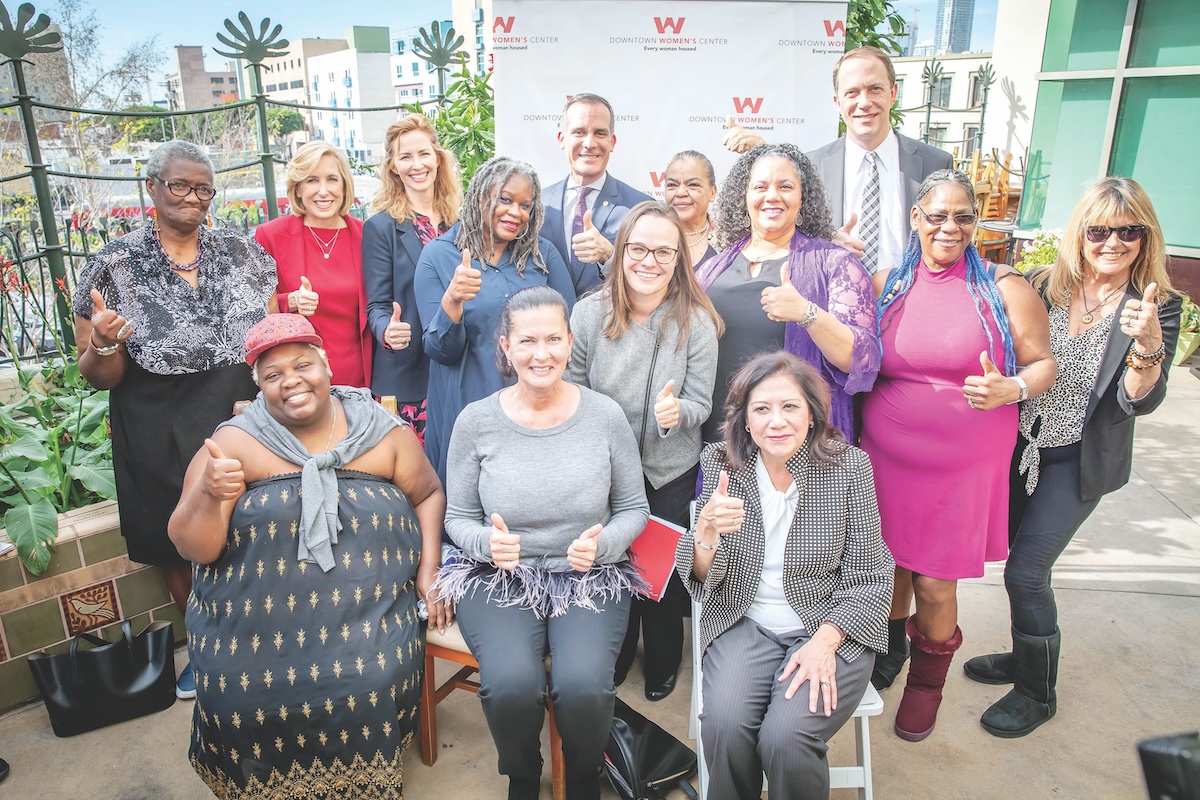
The Downtown Women’s Center, a nonprofit whose mission is to end homelessness for women and gender-diverse individuals by providing safe housing and supportive services, was “founded on volunteerism,” says Amy Turk, their CEO. “It’s one of our heartbeats. Volunteers make it possible for our residents to not just find housing but to truly feel at home, ensuring that everyone can be part of the solution to homelessness.”
Ellen Shane, the executive director of The Emily Shane Foundation, a nonprofit that works to empower underserved middle school students through personalized academic coaching and mentorship, says that it can be a challenge to source volunteers. “We deeply value the individuals who do give their time to our mission in any capacity… We are incredibly appreciative of those who choose to volunteer with us as mentors and tutors – or in any position. Our foundation’s fundraiser event committee members are all volunteers; their participation allows us to present events to raise much needed funds.”
While financial support can and should be a critical part of the volunteering infrastructure, many major philanthropists remind us that it’s the connection with real people that solidifies our sense of purpose.
Melinda French Gates, whose philanthropic focus is wide and deep, explained in her book The Moment of Lift: How Empowering Women Changes the World that “If you want to lift a society up, you need to stop thinking only in terms of big systems and remember to sit with people, to listen to their fears and hopes. The biggest lift comes from seeing another’s dignity.”
Darren Walker, the outgoing head of the Ford Foundation, who has been animated by a critique of “professional philanthropy,” has called for funders to focus on “attention and solidarity” with those that they support. “We need to be proximate to the people we claim to serve.”
This idea of being “proximate” to communities that are supported, most famously articulated by Bryan Stevenson at the Equal Justice Initiative, is at the essence of Silicon Valley Social Venture Fund, or SV2.
SV2, which features a new model of engaging funders, who are called Donor Partners, has distinguished itself through its immersive learning experiences, full integration of community members on its board of directors, and an ethos of true collaboration.
“SV2 is all about community,” says SV2’s CEO David Onek. “With all the challenges in the world today, many people are feeling isolated and hopeless. Coming together in community to make positive change is an antidote to that feeling of isolation.”
After a few seasons of assisting JFCS with their frontline food program, I’m looking forward to my next volunteer adventure with them – supporting the staff with expertise from my professional toolkit of organizational storytelling. It turns out that my deeper dive into the economy of food insecurity, undertaken to help expand the possibilities of others, has expanded my own as well. A rising tide of volunteerism raises all boats.