Jamiah Hargins: Planting Freedom in the Neighborhood, One Garden at a Time

Jamiah Hargins is the founder of Crop Swap LA, a community farming initiative that aims to reshape how Los Angeles neighborhoods think about food. After a career in finance and recruiting, Hargins launched the project in 2017 to provide local produce for his family and neighbors. What began as swapping vegetables in his backyard has grown into a nonprofit that manages 10 active microfarm sites across five neighborhoods.
Crop Swap LA now delivers produce to about 80 families within a two-mile radius. With 30 garden installations completed, a team of 15 staff, and an annual budget of $1.3 million, the organization shows how community farming can create independence from grocery systems and build pride in the neighborhood.
In this conversation, Hargins shares how the movement began, why he sees community farming as a quiet form of resistance, and what it means to give people the power to grow their own food.
Brian Rinker: How did you first get into community farming?

Jamiah Hargins: I got into this in 2017 when my first daughter was born. I went out to my backyard garden and desperately started growing food because I wanted to make sure there was enough food in the house for her. Things in this country were starting to look weird, and I wanted less dependency on outside systems. I started swapping extra produce with other gardeners in the area. They came enthusiastically every month, and somehow I always had an abundance. That made me think: if it’s this abundant, we should be able to sell it and create jobs.
So I rallied volunteers, harvested extra fruit from people’s trees, and started growing food intentionally in yards. Now we have a neighborhood membership model. We aggregate food, wash and bag it, and deliver every Sunday to about 80 families within a mile or two of the gardens. We’ve got a staff of about 15 part time and full time, and dozens of volunteers.
BR: Did you have a background in gardening before this?
JH: No. My background was in finance. I was a stock trader, then a headhunter recruiting leaders for other sectors. But I wanted to do something entrepreneurial and for my family.
I learned gradually from myself and other gardeners. When it came to constructing things, I had mentors with construction or landscaping experience who taught me and my team. Piece by piece, we learned how to install, grow, maintain, and expand.
BR: Do you see community farming as subversive?
JH: Yes. The food system is harmful and one of the real reasons people are sick. It’s too expensive. You can fight against it, but that’s like trying to stop a rolling boulder downhill; you might get run over.
The other option is to let that boulder roll by and build something else to replace it. That’s what we did with Crop Swap LA. We opted out of the existing system and invested in a better one, one that creates local jobs, preserves the environment, gives you better variety, and is more nutritious.
Every day is different. One day I’m finishing a garden in someone’s backyard, the next I’m starting a big project at a school. I might meet politicians or CEOs or just talk with a neighbor on the street. Everyone connects to this mission. A lot of people secretly want to opt out of the grocery system, and we’re giving them a choice.
BR: You’ve called the grocery system “food slavery.” What do you mean?
JH: When I was trading futures, I learned how the system works. Corn and soy are the most subsidized crops, so most farmers grow them whether they want to or not. The government pays for seeds, equipment, and land. That keeps prices artificially low.
Our food isn’t subsidized, so the real cost is higher. If you broke it down honestly, one of our produce bags would cost $400. We bring it down to $20 by using other revenue: garden installations, workshops, tours, and donations and grants.
It’s about choice. If you want freedom from a broken system, you have to pay for it. People have always paid for freedom in different ways. For us, it looks like supporting local food systems.
BR: What principles guide your work?
JH: At Crop Swap we have three guiding principles: intentionality, focus, and simplicity. Intentionality means doing things in the right place and time. Don’t plant something in the shade where it won’t grow. Focus means doing one thing at a time. Don’t try to weed, plant, and fix irrigation all at once. You’ll do them all poorly. Simplicity means don’t overcomplicate things. Choose the simpler irrigation and program design every time.
We also have a five-point framework: legal, financial, humans, operations, and public engagement. Anytime someone brings me an idea, I put it through that framework. If it fails on any one of them, we don’t do it.
BR: Can you give an example?
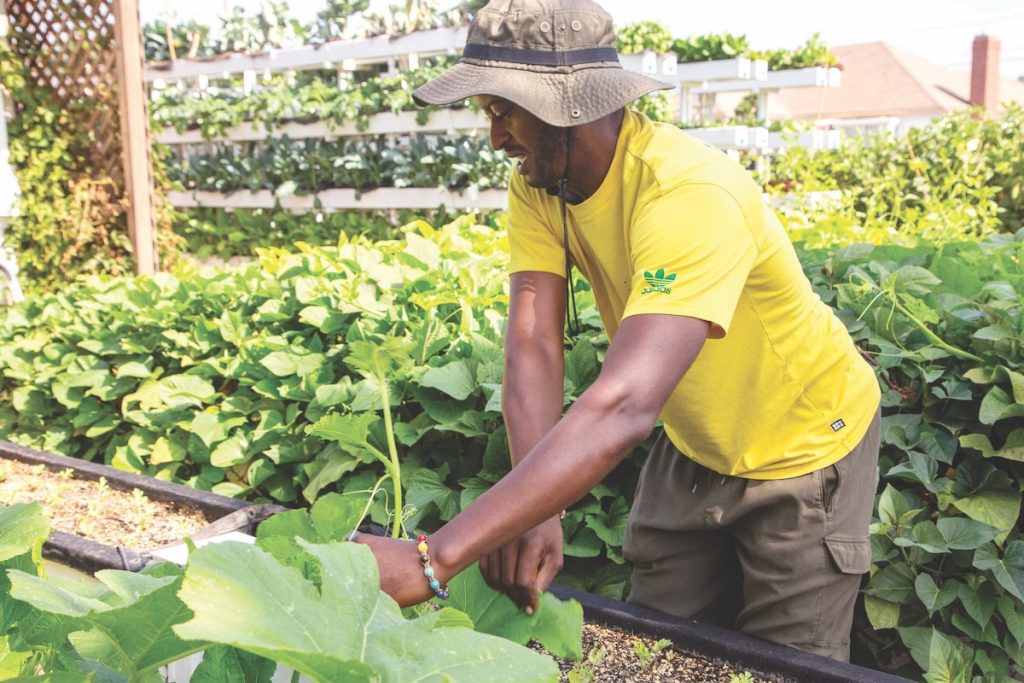
JH: Sure. We just installed a backyard garden. The legal side meant we had both a service agreement and a land use with the homeowner – when we plan to visit, how much water we’ll use, what area of the yard, all that. Financially, each site has a budget. Homeowners also get tax write-offs for the land used, the water, and the food harvested. For example, if we harvest avocados worth $700, they get that deduction.
Humans: it takes one person about two hours a week to maintain a garden. One person can manage four or five gardens a day.
Operations: making sure supplies are ordered, visits are scheduled, and food is distributed.
Public engagement: in this case, the produce goes into our membership program.
That’s the system. If all five points check out, we move forward.
BR: How does gardening and swapping crops affect the community?
JH: First, it’s visual. People drive by and say, “I live next to that microfarm,” or their kids ask when they’ll start a garden. Neighbors stop and tell stories about eating from their grandparents’ gardens. Others honk and yell, “Love your work!”
We also do workshops, tours, donor events, and speeches. We have a farm stand on Mondays where people can buy extra produce and gardening supplies. It raises the spirit of the neighborhood.
Even when there are disruptions, it still feels like progress. Once an unhoused man came into a garden, picked beets, and acted like he worked there. He was messing things up, but he looked peaceful. It seemed healing for him just to be around the plants.
BR: What role does health play in this?
JH: There’s a naturally occurring bacteria in all soil that, when it touches your skin, it causes your body to release positive endorphins. So anytime you touch soil, you will automatically feel happier.
That’s part of why volunteerism is so high. Most nonprofits struggle to find volunteers, but all our weekly slots have been full for a year. People sign up weeks in advance. Families, seniors, young people – they all show up and leave feeling lighter.
BR: How do people get access to your food?
JH: We have a membership model. About 80 families get a weekly bag delivered to their doorstep, we try to keep it hyper local, so members need to live within two miles.
Membership is $80 a month, $20 a bag. We prioritize veterans, disabled people, foster and adoption system graduates, single parents, and families using EBT or CalFresh. Once people join, they almost never leave.
BR: What’s growing right now that excites you?
JH: We’ve got kabocha squash, carrots, peas, beans, lettuce, herbs, corn, green onions, pumpkins, and even watermelon coming through. Every season has something new.