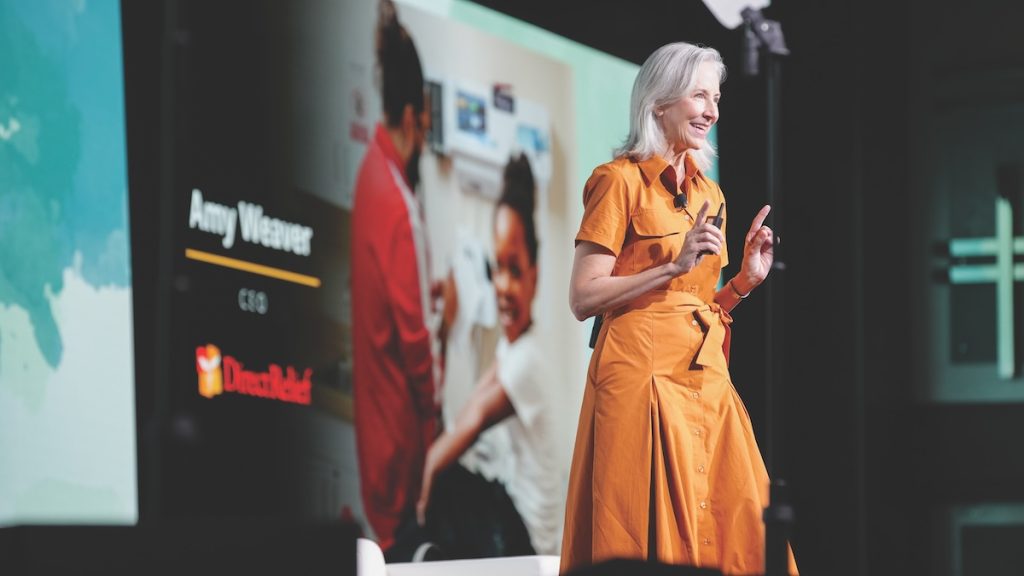
Amy Weaver: Putting Purpose to Work

As Direct Relief’s new CEO, Amy Weaver leads a global humanitarian organization with deep roots in Montecito, where it was founded in 1948. Today, Direct Relief delivers nearly $2 billion annually in medical aid and financial assistance to people facing poverty and disasters worldwide. Praised for running with the efficiency of a leading corporation, the nonprofit consistently ranks among the nation’s top five charities in the United States, according to Forbes. With Weaver taking over the reins in May 2025, Direct Relief is now being run by someone with significant experience in the corporate world.
A Washington State native, Weaver began her career following in her family’s footsteps in the legal profession, working in private practice then as an attorney for a pair of Fortune 500 companies (Expedia, Univar) before rising to chief legal officer at cloud-based software giant Salesforce. She then made the unprecedented move to president and chief financial officer, the first such transition in a Fortune 500 company, and a top one at that, as Salesforce sits barely outside the Top 100 and is one of the 30 Dow Jones Industrial Average companies, having replaced Exxon Mobil in the index in 2020.
Weaver helped guide Salesforce through a period of tremendous growth and transformation to where it posts revenues just shy of $40 billion per year. Now, she’s reached another landmark, as likely the first Fortune 500 CFO to transition from the corporate C-suite to head a humanitarian nonprofit.
Steven Libowitz: How did you decide to move from the corporate world of Silicon Valley into running a humanitarian nonprofit? What made you want to make that leap?
Amy Weaver: From the outside it may look like a sharp jump, but for me it feels like a very natural next step. Service has always been woven into my life. My parents were both constant volunteers, and some of my earliest memories are of tagging along on community projects or civic campaigns. That example shaped me. At Salesforce, one of the things that most attracted me was their policy of giving every employee seven days of paid volunteer time each year. I took full advantage of that. My most meaningful connection was with Habitat for Humanity International, where I served on the board for four years and joined builds in Poland, Kenya, Puerto Rico, and across the U.S. My whole family became part of it. So when the opportunity came to devote myselffull time to humanitarian work, it didn’t feel like a leap – it felt like a continuation of what has mattered most to me.
SL: How does the early installation of justice and fairness coming from a family of lawyers who gave back still show up in your philosophy?
AW: For me, it’s less about the word “justice,” which can sound abstract, and more about basic fairness. I saw that clearly last summer in Uganda, spending time in pediatric oncology wards. The contrast in cancer outcomes between the U.S. and Sub-Saharan Africa is devastating. There’s no way to explain to a child why one receives medicine and another doesn’t – even a five-year-old would recognize the unfairness. Walking through those wards, what kept going through my mind was simple: we can do better, and we must. That sense of fairness, of ensuring people have access to the same chance at health and life, is at the heart of Direct Relief’s mission.
SL: What is an example of an early experience as an adult giving or receiving support that made a big difference in your life or career?
AW: Early in my career, I hit a stretch when nothing at work was going right and my perspective turned pretty negative. At the same time, I started volunteering once a week at our local food bank. It completely reframed how I saw things. The sense of community – donors, volunteers, families who came in for food – reminded me of what really matters. And every week I walked out feeling lighter, as if my own problems had been put back into proportion. That experience taught me that volunteering isn’t only about what you give; it’s about what you gain. My family and I have received so much from service – perspective, gratitude, and connection. In many ways, we’re the beneficiaries.

SL: Salesforce is known as a very philanthropically involved organization. Can you share what that looked like from your perspective?
AW: Their charitable model is amazing. Right from when it was founded, they set up the Salesforce Foundation, with the commitment that 1% of the equity, 1% of the product and 1% of employee time would always go to charitable causes. It wasn’t worth much at the time, but as of now, more than three-quarters of a billion dollars has been given away, and employee volunteer time recently passed the 10 million hour mark. They still allow nonprofits to use their product for up to 10 users completely free, and then beyond that at a discounted rate. Almost 70,000 nonprofits are running on their platform at this point… It’s also very influential to attracting talent because most people care about giving back. As an executive there, I always encouraged my teams to step up and complete those volunteer hours every year.
SL: How do you think other companies can model something similar, making philanthropy part of the culture?
AW: Start as early as possible. You can start small, but you have to start. It’s extremely challenging to reset the organization once you’re already established and public. Salesforce built it into the DNA from Day 1, so it was able to scale as it grew. But on the other hand, it’s never too late. You may not be able to come up with a new financial model, but can immediately implement three or four days a year of volunteer time off. You can look for ways that you can use your product to enhance nonprofits, which costs you almost nothing. There are models that can work with every single organization.
SL: As someone who led at the highest level of a corporation, been involved in nonprofit boards, and now runs one of the largest nonprofits in the humanitarian sector, how has your perspective on philanthropy evolved over time? Or perhaps, what can nonprofits learn from the corporate world?
AW: I’ve found the learning goes both ways. Some of the best practices I brought into Salesforce came from my time with Habitat for Humanity. And in turn, the corporate world taught me a lot about the power of transparency – proxy statements, SEC filings, investor reports – all of which force accountability and fuel improvement. Nonprofits don’t always have the same forced discipline, but I think they should. At the end of the day, whether in business or in humanitarian work, the fundamentals are the same: strategic focus, financial responsibility, operational excellence, innovation, and above all, trust. What changes is the purpose. Here, those same skills are deployed in service of people who are sick, displaced, or left behind. That’s what makes it both motivating and humbling. I often walk through our warehouse, passing the pallets of medicines and supplies bound for clinics around the world. I touch them as a reminder: every shipment represents lives depending on us. That’s a responsibility I carry with both honor and urgency.
SL: What is the role of philanthropy in building community?
AW: Going out of your way to support someone else is truly the definition of a community. You’re coming together because you believe that there’s something better and that people acting together can build something that is better than you can do individually. It also breaks down barriers. We live in a very divisive society right now, and yet you can find people who come together around common goals when it comes to philanthropy. The more things we can look to that bring people together towards a single goal, the better off we’re going to be.
SL: Speaking of divisive times, there’s been a massive cutback in governmental support, especially internationally. Do you see that as an opportunity or even responsibility for private philanthropists to step up to try to fill that void?
AW: Let’s put it this way: if people have been waiting to know when they could have the most influence with their donation, the answer is now. Organizations are either facing incredible cuts, whether it’s from a lack of government support or other factors with the economy, or if they’re not, then like Direct Relief they’re in a position to step up and do more. In either case, what they need is funding. So if people have been holding back, if they’re waiting for the right time to make a commitment, to make a gift, to really try to make a difference, the time is now.
The recent changes have been a tsunami going through the development world. I believe if you are in a position to do more – like we are at Direct Relief – you really have an obligation to do so. This is the moment. It’s the moment for donors, it’s the moment for nonprofits. It’s the moment for everyone to really step up.
SL: Before joining Direct Relief, how did you choose which nonprofits or causes to support?
AW: I would love to say that they’re always very well thought out decisions. But often it was something that just caught my eye and touched my heart. But in general, my husband and I always look at where we can make the most impact – whether it’s helping a small handful of people in a substantial way that will change their lives, or something that is going to have a much broader and wider impact on more people by leveraging expertise and context.
Either way, I think about something I heard as a student at Wellesley from William Saltonstall who told us that the most important advice he could give us about philanthropy was to always give to a general fund or unrestricted donations. He said, whoever you’re giving it to, they know better than you where it’s needed.
SL: Any final thoughts on wealth, philanthropy, and giving back?
AW: I believe the saddest thing anyone could say at the end of their life is that they wasted their potential. The opposite is to be able to say: I used what I had – my gifts, my resources, my time – to make my family, my community, and the world better. That’s the legacy I hope for. It’s not enough to do your job well; you have to ask yourself, did I do all I could with what I was given? That’s the measure I want to hold myself and Direct Relief to.